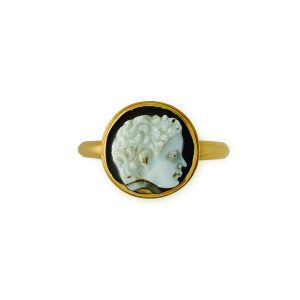
A hardstone cameo of Cupid mounted in a ring
1st Century BCE
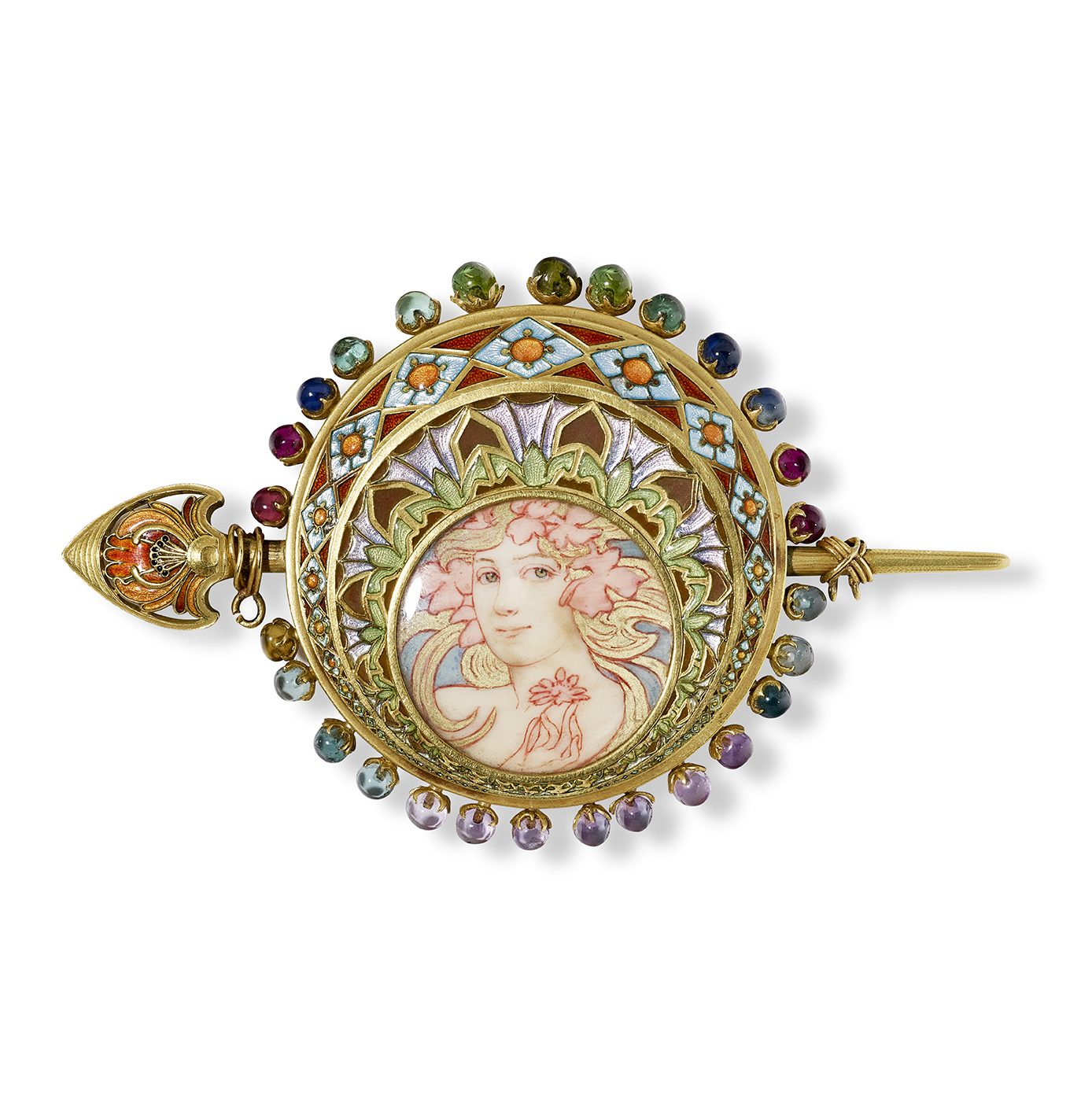
of circular form centred with a portrait bust of a female figure painted in pastel tints, the hair picked out in gold paint, surmounted by two crescent-shaped bands, the inner crescent decorated with stylized floral motifs, the mauve petals and green enamelled leaves against a plique-à-jour enamelled ground, the outer crescent applied with geometric stylized flowers enamelled blue and amber against a deep amber ground, the whole bordered with gold mounted vari-coloured precious beads including garnets, tourmalines, amethysts, and aquamarines, the horizontal pin with an enamelled finial.
The jewel was designed by the Czech-born and Paris-based painter and graphic artist Alphonse (né Alfons) Mucha (1860-1939) and was exhibited by Georges Fouquet (1862-1957) at the 1900 Exposition Universelle. Archival photographs show the pin originally supported asymmetrical chains hanging on each side of the jewel suspended with various baroque pearls and semi-precious stones, some set in gold cage mounts.
Ivory licence: FPZWH5G9
See no.82 (pg 84-85) of ‘From Function to Fantasy, The Brooch: From 1200 BCE to the Contemporary.’
The Fouquet dynasty is a remarkable one in that all three of its generations incarnated the prevailing movements of their respective time, namely the Neo-Renaissance, Art Nouveau and Art Deco. Founded by Alphonse Fouquet (1828-1911) in 1860, the firm was taken over by his son Georges (1862-1957) in 1895 and continued by his own son Jean (1899-1984). Alphonse began his arduous apprenticeship at the age of 11, subsequently working for different makers who specialised in gold jewellery including Alexis Falize and Jules Chaise. From 1855 he was collaborating as a modeller and designer with respected art jeweller Léon Rouvenat. Once he had established himself on his own account in 1862, he created delicate filigree jewellery set with cameos, miniatures and painted enamels. By 1868 he was employing over 30 craftsmen, producing jewellery for export to Europe and South America, specialising in turquoise or onyx pieces set with diamonds. His success enabled him to exhibit gem-set jewellery at the 1878 Exposition Universelle, as well as pieces inspired by the antique, for which he won a gold medal.
Most notable were his works in the Renaissance taste of chased gold, often depicting mythological creatures and incorporating historicist painted enamel portraits. Appointed Chevalier of the Légion d’Honneur in 1888, his contribution to the 1889 Exposition won him a gold medal. He had moved his premises in 1879 to 35 avenue de l’Opéra, where his son joined him in partnership in 1891, taking over four years later. George’s close collaboration with the designer Charles Desroziers (1865-1927), a former student of the artist Eugène Grasset, lasted from 1898 until 1914. They produced distinctively harmonious creations often combining opals with translucent shimmering enamels to create lyrical landscapes or cascading botanical motifs. For the 1900 Exposition Universelle, Fouquet also displayed a remarkable series of works produced in collaboration with Alphonse Mucha, where his display of jewellery earnt him a gold medal.
Continuing to create works with Desroziers and the talented enameller Etienne Tourrette (1875-1924), a pupil of Louis Houillon, he participated in a number of European exhibitions. Geometric forms began to feature in his work around 1910, which continued after the First World War as he resumed his work with Louis Fertey, the engraver he had taken on prior to 1900 and who had soon become his workshop manager. The most significant works submitted to the 1925 Exposition were designed for Fouquet by the artist André Leveillé, as well as by Fertey, who contributed startling geometric masks. Both were awarded a Grand Prix for their designs. Jean Fouquet had been working with his father as a designer since 1919, and four of his pieces were included at the Exposition. He continued to compose highly structured works in silver, white gold, platinum, and later of polished or chromed steel. Production slowed down after 1930, although both Fertey and Jean Fouquet were awarded a Grand Prix each for their designs at the Exposition Coloniale of 1931. The firm closed down in 1936, Jean Fouquet continuing to create jewellery designs into the late 1950’s.
It was his short-lived collaboration with Mucha (1899-1901) that led Georges Fouquet to be considered a chief exponent of the Art Nouveau movement. The first jewel to derive from their association was a famous snake bracelet connected by chainwork to a ring, created for the great tragédienne Sarah Bernhardt (1844-1923) in her role of Medea, in 1899; Mucha had been producing the posters for her theatrical productions since December 1894. For her role as Medea, launched on 28th October 1898, he had depicted her wearing a spiralling snake bracelet that terminated on her hand. A surviving design annotated by Fouquet con rms the date of their first joint project.
The astonishing works designed by Mucha for Fouquet’s 1900 display were highly distinctive, from head pieces that cascaded well below each ear, to shoulder ornaments and bodice decorations that crossed over the body and were suspended with painted miniatures or charms dangling from chainwork. Their Byzantine spirit was much commented on at the time, and indeed Mucha regarded the Byzantine civilisation as the root of Slavic culture. Although the scale and elaborate constructions of the exhibited works challenged the traditional way jewellery was to be worn, critical reception was mostly positive, and their undeniable artistry and impeccable execution much praised. So successful was their partnership that Georges Fouquet entrusted Mucha with the design of the façade and interior decoration of his new premises at 6 rue Royale, which opened in 1901.
Ornamental devices such as that of the crescent halo were also present in the exuberant ornamental scheme; the location was turned into a work of art in its own right.
Two circular projects for miniatures by Mucha survive which formed part of an exhibition devoted to his work in 1980. They are described as ‘crayon, aquarelle, trace de dorure sur carton’ (pencil, watercolour, traces of gilding on board), and were formerly in the collection of Georges Fouquet. One features a portrait bust of a female figure holding a quill pen, while the other is a preparatory design for the miniature contained in the exhibited jewel, and very slightly larger at 3 cm in diameter (compared to 2.85 cm).
Both miniatures formed the centre of identically decorated enamelled mounts. The only differences between the two works are the diamonds with which the pin of the ‘quill’ example was set, and the suspended stones and pearls which varied in number and type. The ‘quill’ example is intact and the ‘flower’ version is revealed for the first time in the exhibition ‘From Function to Fantasy, The Brooch’, having thought to have been lost. Surviving jewels from Fouquet and Mucha’s artistic collaboration are extraordinarily rare and demonstrate the versatility and prodigious talent of two renowned artists at the pinnacle of their respective careers.
For further information about this piece, please visit or contact us.