A jewelled antique brooch by Cartier
Paris, circa 1912

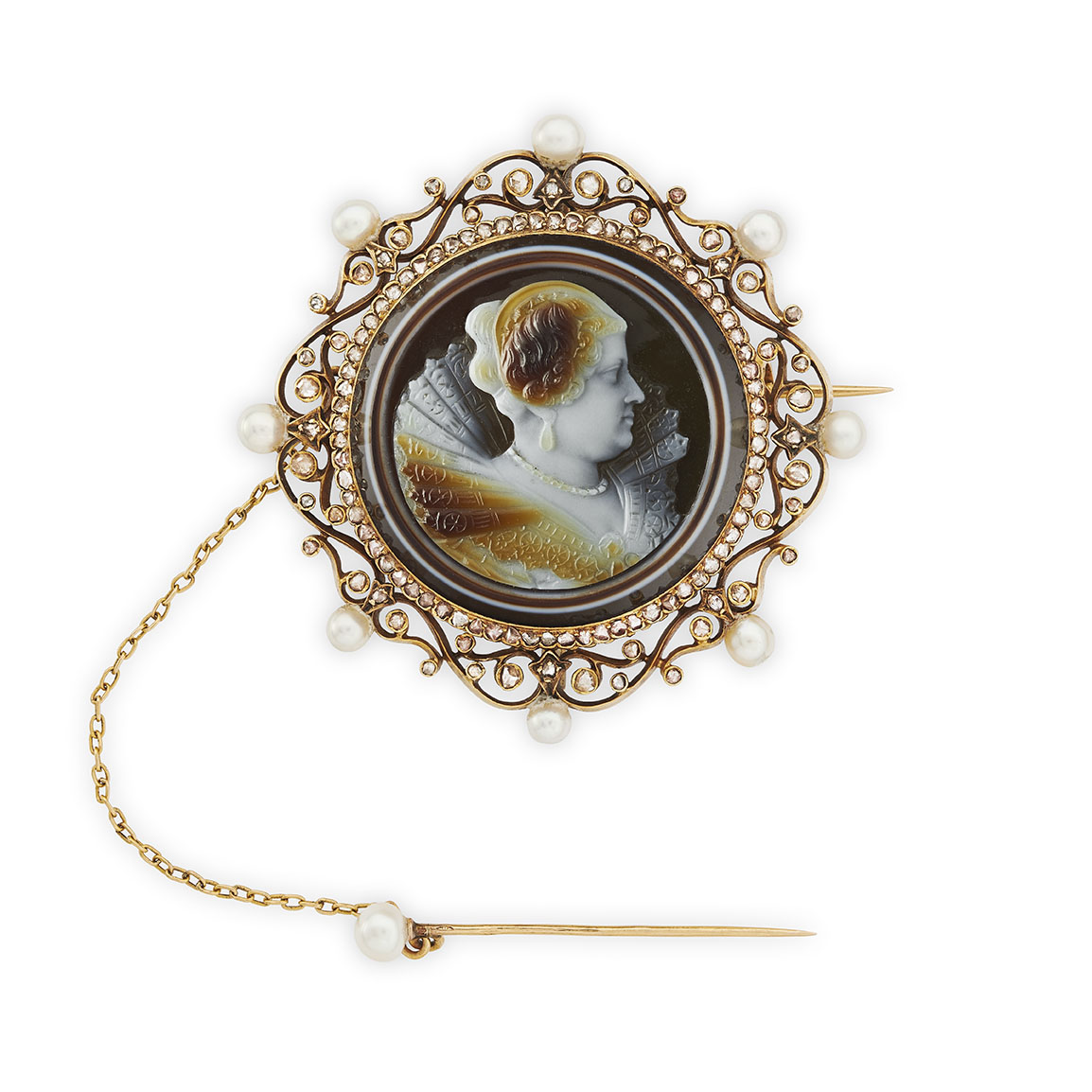
centred with a circular sardonyx cameo by Georges Bissinger depicting Maria de’ Medici (1575-1642), Queen consort to King Henry IV of France, wearing a lavish stiffened lace ruff and sumptuous jewellery, surrounded by a intricately pierced gold border composed of diamond-set scrolls which echo the lace depicting in the carving, the eight intersections punctuated with a single pearl.
See no.48 (pg 45) of ‘From Function to Fantasy, The Brooch: From 1200 BCE to the contemporary’ (Wartski, 2025).
The brooch was created by the firm of Baucheron and Guillain, who supplied jewellery to many of the most prominent Parisian retailers including Frédéric Boucheron and Gustave Baugrand. Louis Baucheron (1826-1905) trained with Marret et Jarry Frères,where his father was workshop manager. He established his own business in 1860 and formed a partnership with Guillain, who had worked for Deschamp, the successful Palais-Royal jeweller who traded under the business name of Tixier Deschamp. The firm was eventually taken over by distinguished designer and jeweller Georges le Saché, who had spent five years under the tutelage of Alexis and Lucien Falize, but left in 1877 when he married Baucheron’s daughter.
Johan Georg Bissinger, known as Georges Bissinger (1836-1912) and originally from the German town of Hanau, was a distinguished gem-carver best known for his recreation of Renaissance engraved gems. His portraits of Renaissance queens, including Elizabeth I, Mary, Queen of Scots and Maria de’ Medici, were particularly sought after by English jewellers such as Carlo and Arthur Giuliano as well as those in Paris. Frédéric Boucheron displayed a necklace set with cameos by Bissinger at the 1867 Exposition Universelle, and the engraver himself was awarded a silver medal for works exhibited there under his own name. He participated in the International Exhibition of Vienna in 1873 as well as the exhibition organised by the Union Centrale des Beaux-Arts appliqués à l’Industrie in 1876. Lucien Falize noted in his Rapport Bissinger’s use of a diamond-set lathe turning tool to pick out the detailing of lace rus. In his display at the Exposition Universelle of 1878, Bissinger presented 112 gems, many taking their inspiration from Renaissance cameos, coins and medallions in the ‘Cabinet des Médailles’ of the Bibliothèque Nationale. He almost certainly copied this likeness of Maria de’ Medici from a 17th century bronze medal created by Court medallist Guillaume Dupré (1579-1644), an example of which is preserved at the Harvard Art Museums.37 It is dated 1615, when she served as Queen Regent to her son Louis XIII.
Numbered ‘1241’ on the reverse, this cameo exemplifies the engraver’s prodigious technical skill in the carving of lace in three layers of striated sardonyx. The extravagant upright ruff that was open at the front was known as the Medici ruff; Maria de’ Medici had introduced it to France when she first came to that country to marry Henri IV in 1600.
For further information about this piece, please visit or contact us.