
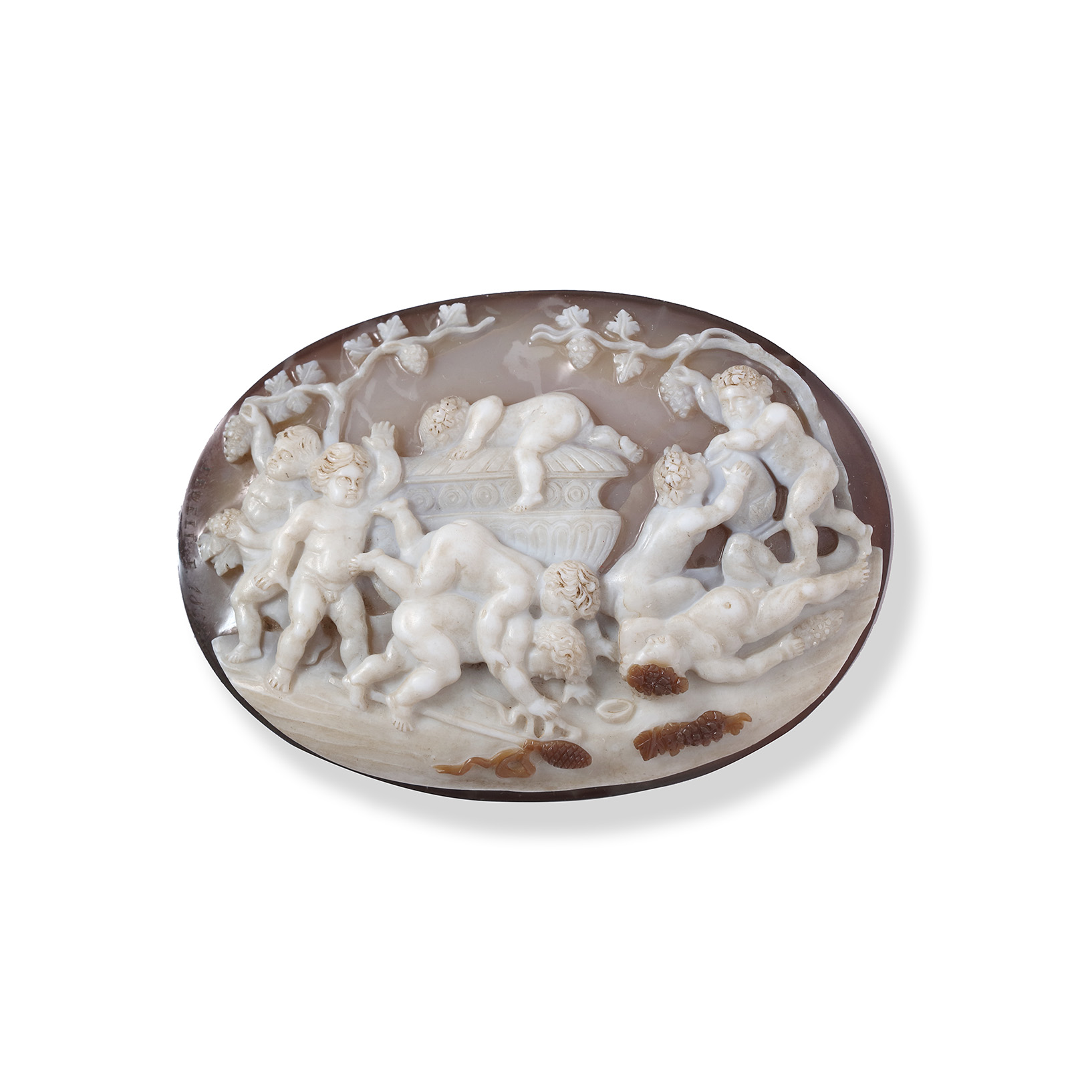
in the manner of François du Quesnoy (1597-1643), deeply carved into a multi-layered black and white sardonyx depicting a complex bacchanalian scene of writhing and brawling putti, the centre of the composition occupied by two wrestling figures with the thyrsus of Dionysus and an empty drinking vessel lying on the ground, to their right a standing figure feeds another putti wine, whilst beneath them reclines an inebriated figure on the ground, towards the back of the composition stands a large amphora into which a putti is leaning and on the lefthand side stands a figure picking grapes from two vines which frame the scene, a final figure chastises (or encourages) the two wrestlers.
The front of the cameo engraved ‘FEDELI F’ for ‘FEDELI FECIT’ and dated 1852.
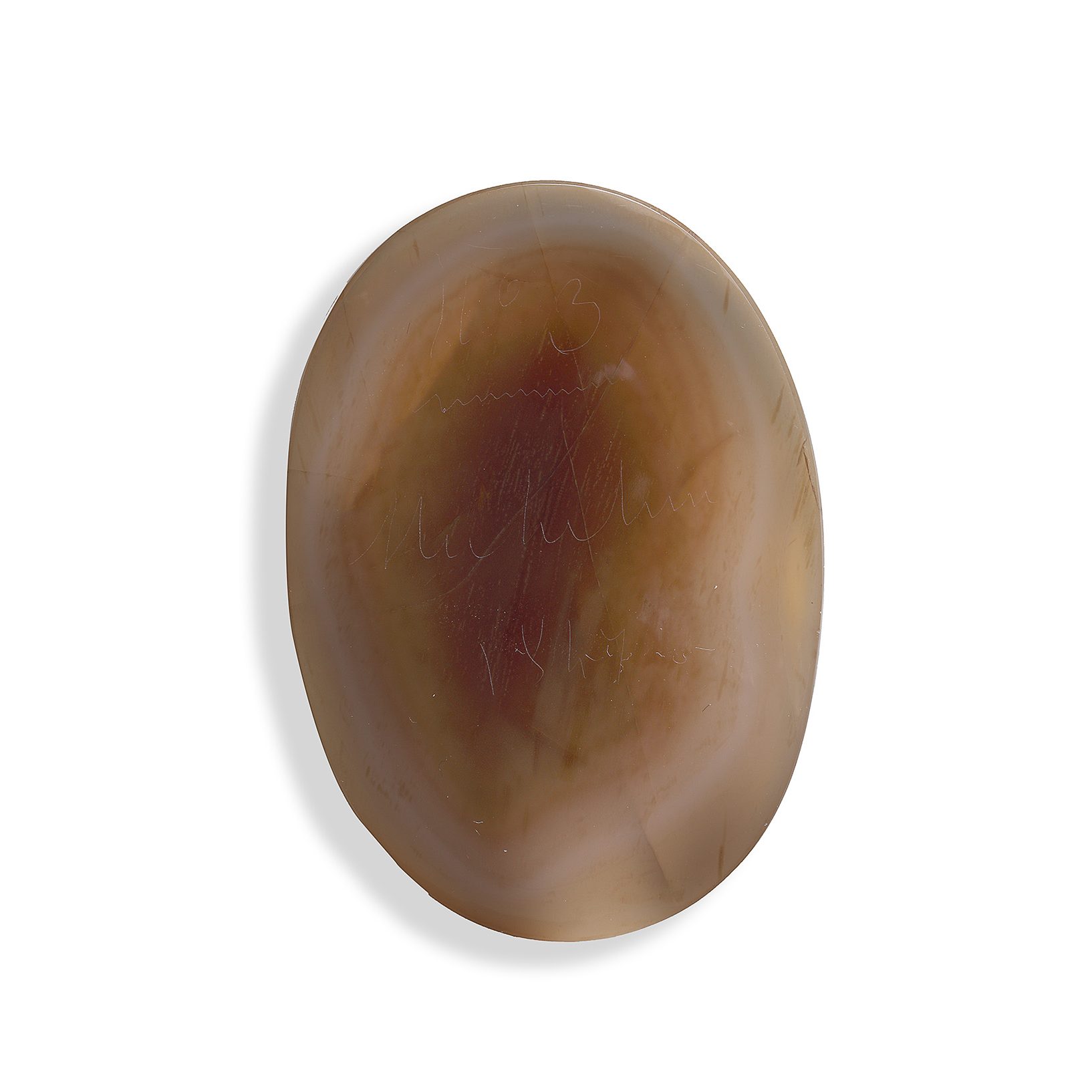
The reverse of the cameo inscribed faintly ‘No.3, Michelini, 1847.’
Fedeli was copying a seventeenth century composition which would have been well known in the nineteenth century. An ivory panel circa 1650-70 in the Victoria and Albert Museum depicts a near identical scene as that on this cameo (accession no.1063-1863). The panel is part of a series of six carved bacchanalian ivories, the artwork for which is attributed to François du Quesnoy or artists working in his circle. Other examples of the same six scenes can be found reproduced in materials such as ceramic, plaster and bronze and were no doubt conceived as a decorative scheme for palatial interiors.
It is interesting to compare the cameo with the famous drawing completed by Michelangelo entitled ‘A Children’s Bacchanal’ (now in the collection of His Majesty King Charles III). Michelangelo’s masterpiece was published as an engraving several times (for example by Carlo Losi in 1775) and was almost certainly known to du Quesnoy and his contemporaries. One similarity is striking, the child depicted climbing onto the lip of the barrel. This detail is closely comparable to the central figure of both the ivory carving and the cameo.
The cameo is signed by the gem engraver Fedeli, who Enrico de Keller records in 1830 as working at number 81 via Vittoria in Rome. It is also signed on the reverse with the name ‘Michelini’, who likely refers to the Roman born engraver who was working in Paris by 1839. The presence of this second signature may suggest that Fedeli was working from a sardonyx blank prepared in Michelini’s studio. The scratched date of 1847 on the reverse of the cameo may record the date the blank was prepared, whilst the date of 1852 on the front records when the cameo was completed.
Luigi Michelini was born in Rome and was a student of the Girometti family, master cameo carvers working in the city. In 1839, Michelini is described in a guidebook of Paris as ‘considered to be the cleverest engraver.’ In 1855, he displayed seven works in the Paris Salon.
There are several examples of cameos signed and dated by Michelini on the reverse in an identical manner, including several illustrated in “Nouveaux inédits by G. Girometti and L. Michelini“, p. 83-88 in Bulletin de la Société Française de Numismatique, vol 52.5 (May 1997) by Michel Duchamp. These examples have been attributed to Michelini with the absence of a further signature. There are also other precedents for numbered cameos attributed to Michelini, the numbers possibly referring to the size and shape of the blank.
Contact Wartski
For further information about this piece, please visit or contact us.