
of elongated lozenge form, decorated with a powder blue guilloché enamel, mounted centrally with a brilliant-cut diamond surrounded by a diamond circle, flanked by foliate motifs.
Workmaster: August Hollming
Illustrated:
See no.257 (pg 231) of ‘From Function to Fantasy, The Brooch: From 1200 BCE to the Contemporary.’
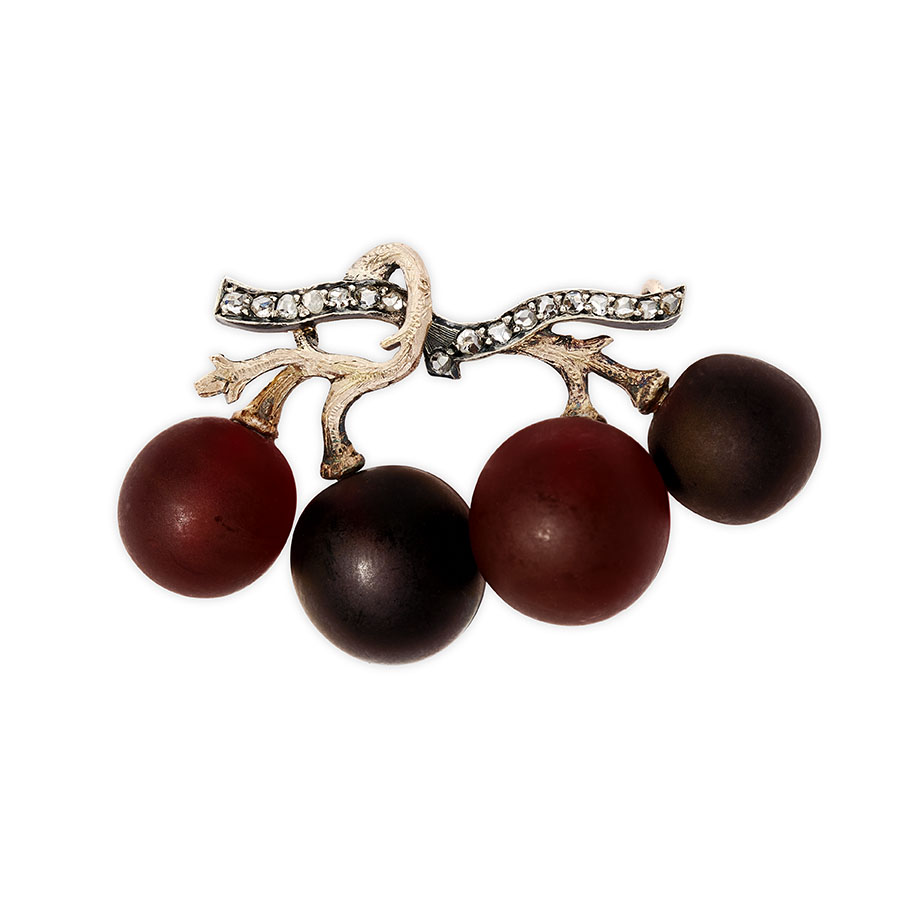
Georges Fonsèque (d.1939) and Emile Olive (1853-1902) made a specialty of these brooches in the form of grapes composed of red or green frosted glass, numbering two, three or four berries, sometimes mounted with gold or diamond set vine leaves. They were originally contained in miniature wooden wine crates stamped with ‘Chasselas de Fontainbleu’ on the exterior; also known as Chasselas de Thomery, this was a Chasselas grape variety grown in the Seine et Marne region that was cultivated ‘en espalier’ (ie. wall mounted). A green glass grape brooch has even survived with a secateur forming part of the composition. These charming jewels were produced from 1889 onwards; four years earlier, Olive had invented coffee bean brooches with a fitted case in the form of a coffee husk.
Emile Olive had from a young age shown a predilection for drawing and trained with his uncle M Larchevèque, who was a jeweller. By 1873, he had joined Lucien Falize as a designer, collaborating on a number of works displayed by the firm at the 1878 Exposition Universelle. He left in 1885 to form a partnership with long-standing friend and skilled jewellery manufacturer, Georges Fonsèque. Within a year they had launched the medal jewel, commissioning engraver Emile Vernier to make a ‘Diane’ prototype for them. Although its success took time, their gold versions of the designs produced by graphic artist Jules Chéret immediately appealed and the revival of the medallist’s art can be credited to the firm.
Olive’s inventive designs gained the firm a distinguished reputation, and they collaborated with Vever on the firm’s display at the 1889 Exposition Universelle. Mourning jewellery composed of onyx formed part of the Fonsèque et Olive repertoire; sinuous and elegant diamond-set designs were also introduced to their stock. Fonsèque continued to run the business after his partner died in 1902.
Surviving grape brooches by Fonsèque et Olive are often composed of green glass, which has had a tiny quantity of uranium added to it prior to melting to give it fluorescence. The red glass examples are rarer, and this is so closely observed that the stalk that is missing one of the grapes has even been depicted.
Contact Wartski
For further information about this piece, please visit or contact us.