Provenance:
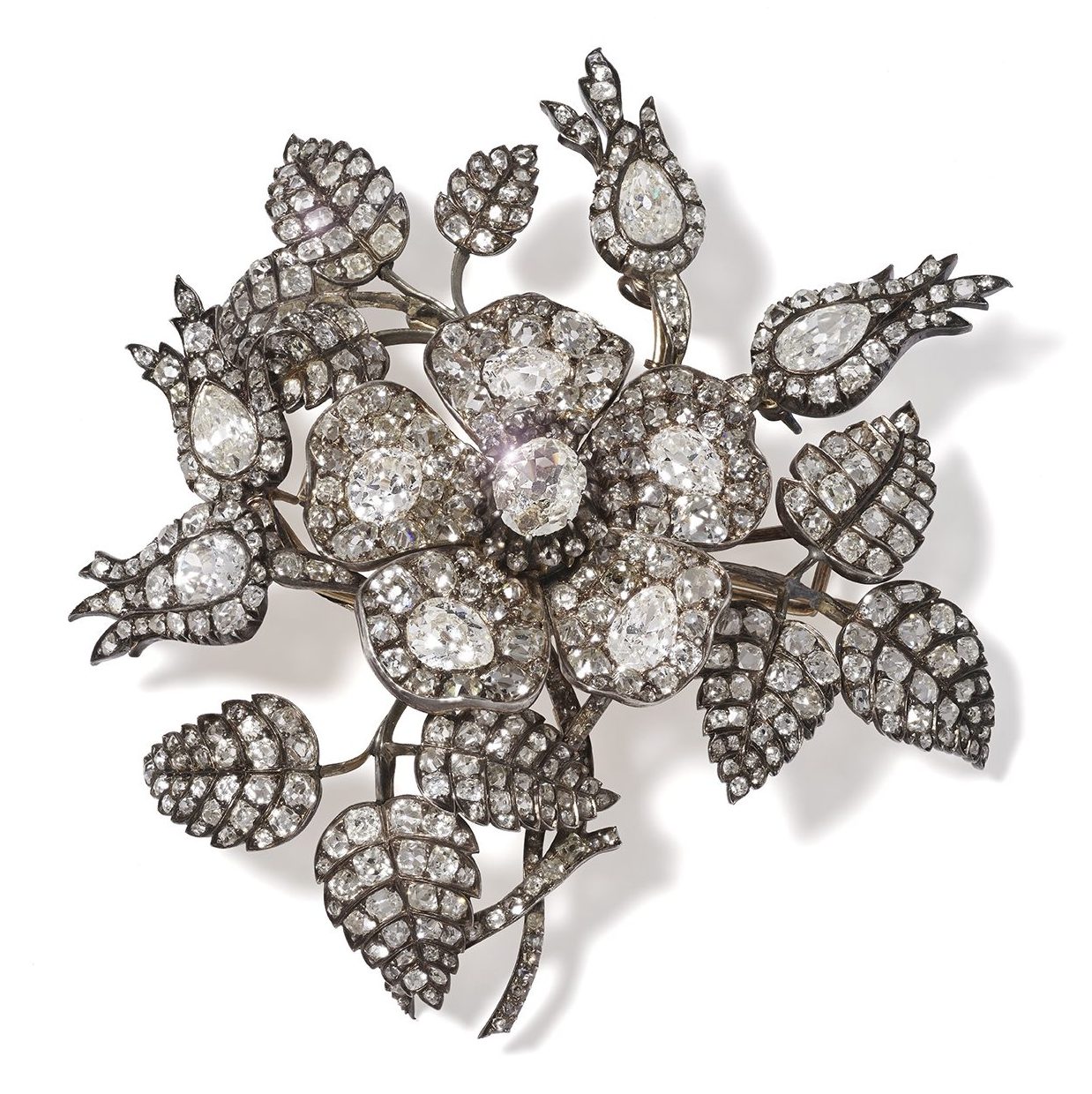
The brooch belonged to Princess Katarina Pawlowna Bagration, Countess Skavronsky (1783-1857), the wife of Prince Pyotr Ivanovitch Bagration (1765-1812). He was the son of Ivane Bagrationi, a descendant of the Georgian Royal dynasty. A Russian general and hero of the Napoleonic wars, Prince Pyotr would be mortally wounded during the battle of Borodino in the outskirts of Moscow, in 1812. The Princess’s father was Count Pavel Martinovich Skavronsky, Chamberlain of the Royal Court, whose own father Count Karel Samuiloch Skavronsky was the eldest brother of Catherine I of Russia. A niece and favourite of military leader and statesman Prince Grigory Potemkin, Princess Katarina was educated at the Court of Empress Catherine the Great and served as lady-in-waiting to Empress Marie Feodorovna, second wife to Tsar Paul I. Her marriage in 1800 to Prince Bagration was an unhappy one and by 1805 she was living in Vienna, soon embarking on a relationship with diplomat Klemens von Metternich who in 1810 fathered her daughter, named Marie-Clementine after his own name.
A celebrated beauty, Princess Bagration hosted a lavish ball in honour of Tsar Alexander I in 1815 to coincide with the Congress of Vienna; her famously flattering white muslin attires would be worn by her for the rest of her life. She moved to Paris the same year, where she continued to live in considerable splendour, her circle of friends including members of the French aristocracy and illustrious authors such as Honoré de Balzac and Stendhal.
It was her passion for luxurious jewellery that drew her to Jean-Baptiste Fossin, where she remained a devoted customer for some forty years. Amongst the many opulent jewels he made for her were a pair of earrings hung with briolettes that had belonged to Queen Marie-Antoinette. They were listed in the Bagration inventory compiled by the firm in 1836. So too was a sumptuous pink spinel and diamond-set parure consisting of a tiara, comb, necklace and earrings.
Illustrated:
See no.139 (pg 142) of ‘From Function to Fantasy, The Brooch: From 1200 BCE to the Contemporary.’
This detailed observation of an ‘églantine’ in full bloom is miraculous, the three-dimensional quality of the spray admirably translated into a graceful diamond-set confection. The historian Henri Vever indexes Fossin as a ‘peintre et sculpteur’ as well as ‘joaillier orfèvre’: ‘Truly talented, Jean-Baptiste Fossin was a distinguished artist who drew as effortlessly as he spoke. […] He was the first of contemporary jewellers to attempt a return to nature; this was evident in the attractive sprays he both designed and interpreted in diamonds. In this way he revived the traditions of Lempereur and Pouget […]’.
On 18th January 1830, the Princess married the British general and diplomat Sir John Hobart Caradoc, 2nd Baron Howden of Howden and Grimston; she was fifteen years his senior. They would file for a formal separation some years later. The brooch dates from around the period of their marriage and remained with family descendants until the 1990’s. It is a rare survival of diamond-set Parisian jewellery of the earliest decades of the 19th century by the acknowledged master of gem-set botanical studies.
Contact Wartski
For further information about this piece, please visit or contact us.